

Keystone Vape
- Status
- Finished
- Project period
- 2022.11 - 2024.05
- Role
- SEO / Brand Operations Manager
Keystone Vape Project Review
Project review date: December 2025
From November 2022 to May 2024, I was responsible first for SEO and later for brand operations at Keystone Vape, gradually becoming the lead for online marketing.
The most important value of this experience was not how much website traffic I generated. It was learning to rethink how online marketing should support commercial growth in a regulated industry that depends heavily on distributors.
How the Work Unfolded
After leaving Lisen Technology in June 2022, I spent several months learning front-end development, initially hoping to build and sell Shopify themes. That attempt did not succeed, but it helped me understand website structure and development collaboration. I then joined Keystone Vape as an SEO specialist in November 2022.
When I joined, the company had approximately 16 people and was centered on R&D and product development. Its primary business was ODM, OEM, and product solutions. The company later shifted its focus toward building an international proprietary brand. The website was no longer only a tool for collecting factory-business inquiries; it also had to support brand presentation, product education, and market development.
My work consequently expanded from SEO acquisition into website upgrades, brand content, influencer marketing, and regional market experiments. For the website upgrade, I was responsible for the overall plan, project pace, and development follow-up. The designer produced the visual design, and an external team handled development. The brand collaboration team grew to approximately six people, with two reporting directly to me.
Because vape products cannot reliably use conventional advertising channels, SEO and social content are especially important. Large distributors, however, do not place orders because of one article or one exposure. Online content plays a longer-term role: helping potential customers understand products, verify the brand, and reduce uncertainty throughout an extended decision process.
SEO Showed Me the Distance Between Traffic and Business
At the time, more than 70% of the keywords with realistic traffic potential were either other vape brands or product-model keywords under those brands. My strategy was therefore to systematically publish reviews of other vape brands and products, using brand, model, and long-tail queries to expand keyword coverage, then supporting commercial pages for wholesale, ODM, and OEM through internal links.
In the later stage, approximately 80% of the content was produced with AI assistance. I still provided the topics, keywords, factual information, and content direction, and every article went through human review and fact-checking before publication.
According to SEMrush, the website peaked at 19,298 organic keywords in December 2023, with estimated monthly organic traffic of approximately 42,000. These figures are third-party estimates and do not equal measured traffic in the website backend. Core B2B keywords remained in the top five for roughly six consecutive months. Later, as the company shifted toward brand building, the homepage positioning and title changed, and ODM/OEM keywords were no longer a continuing priority. The ranking period therefore should not be interpreted simply as SEO performance lasting only six months.
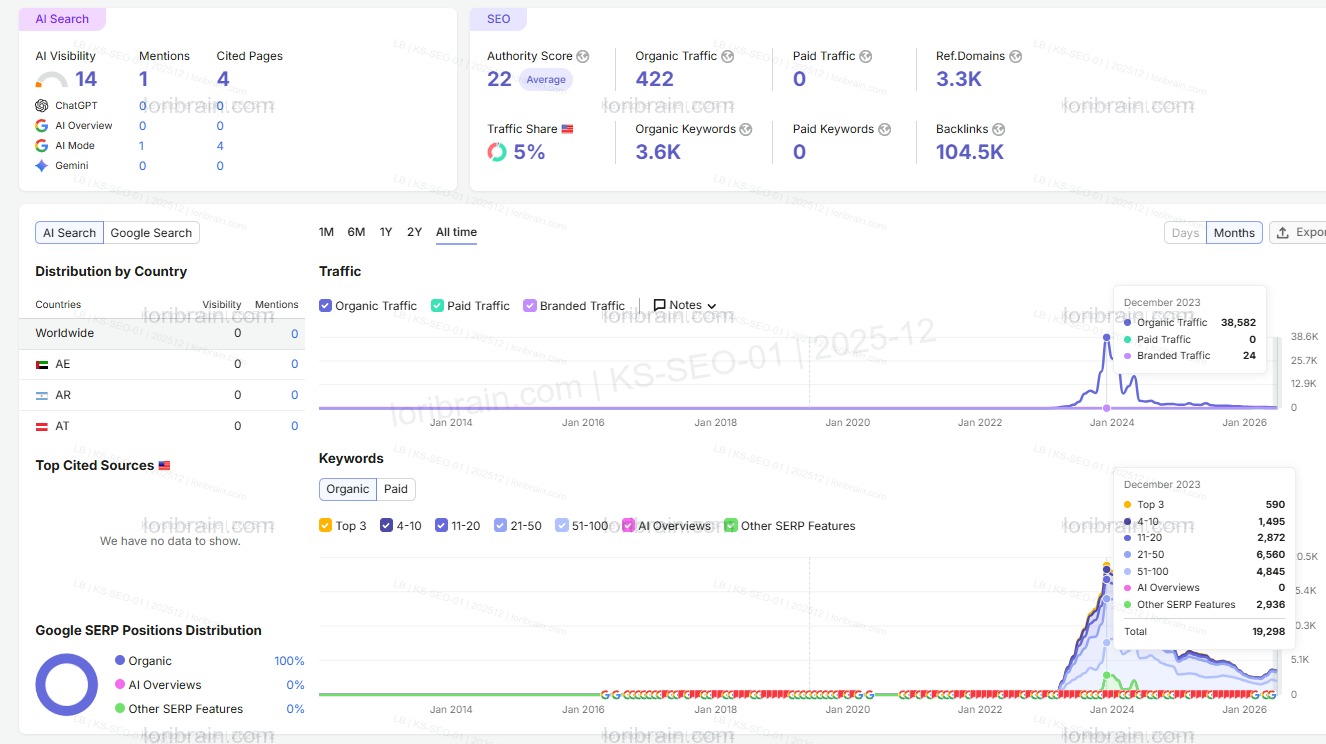
After traffic grew, the website generated approximately 80 inquiries per month, but around 80% came from consumers, small orders, or requests below the MOQ. Only a handful had realistic potential to become national or regional distributors.
At the time, I was more likely to call them “invalid inquiries.” Looking back, they were not necessarily invalid demand; they simply could not be served by the ODM/OEM model we had at the time.
SEO proved that market attention existed, while also exposing the company’s lack of a transaction path and a mechanism for serving that demand.
From Fragmented Exposure to Regional Market Development
I did not complete these projects alone. From broad influencer collaborations and community experiments to regional market tests, Frank and I were the core participants and made most decisions together. There was no established answer in the industry; we were learning by doing within the information and resources available at the time, and Frank consistently supported me in moving these experiments forward.
The first round of influencer collaboration used a five-figure US-dollar budget, but the creators were spread across several countries. We did not create sustained exposure in a priority market, and the work lacked coordination with local sales and offline channels. We produced a collection of content, but we did not create a market.
I later changed the approach toward sustained development in a specific region. For the South Africa initiative, I was responsible for finding a stable group of vertical creators, sending products regularly, and maintaining long-term posting so that the brand appeared repeatedly in front of the same target audience.
For Consumers
Build local exposure, product content, and brand familiarity over time.
For Distributors
Use the content in distributor presentations and sales materials to demonstrate local audience interest and the ability to support future sell-through.
The same content asset could create consumer demand while also reducing a distributor’s uncertainty about working with the brand.
The South African market achieved sales after I left the company. I do not have complete follow-up sales data, so I cannot attribute the result entirely to influencer content. It does, however, suggest that regional focus, repeated exposure, and sales coordination are closer to an effective market-entry model than fragmented campaigns spread across countries.
A Platform Decision I Chose Not to Pursue
A sales team from a B2B platform visited the company several times, presenting many successful cases from the vape industry and encouraging us to invest approximately RMB 100,000 to open a store.
Those cases showed that the platform might offer an opportunity, but sales materials naturally concentrate on successful merchants. They did not answer questions about failure rates, true customer-acquisition costs, or long-term returns. The platform also offered no low-cost way to validate the opportunity quickly, so I ultimately decided not to participate.
Looking back, the decision was not necessarily wrong, but my judgment relied mainly on experience and risk intuition. If I handled it again, I would model revenue, acquisition cycles, worst-case losses, and opportunity costs under several probability scenarios before deciding whether to invest.
What I Really Lacked Was a B2B Strategy
During my time at the company, I worked on SEO, the website upgrade, content, team building, influencer partnerships, and regional experiments, but the commercial outcome did not meet my expectations.
As the lead for online marketing, I was too often asking, “What else can we do online?” I did not begin by asking, “How should Keystone Vape win its next B2B market?” and then work backward to define the strategy.
Looking back, there were four main gaps:
- We did not select one or two priority countries early enough.
- We did not define a clear target-distributor profile or path to breakthrough.
- Online marketing and local sales did not jointly design the market approach from the start.
- We paid more attention to traffic and exposure than to commercial indicators such as qualified opportunities, sample progression, distribution, and repeat orders.
The problem was not that every individual action was wrong. The problem was that those actions were not organized by a clear B2B market-entry strategy.
How I Now Think About B2B and B2C
After completing community, influencer, and regional market tests, I repeatedly proposed launching a B2C independent website to Frank. The existing website had already shown that consumers were interested in the products, but there remained a long distance between “interest” and actual use, satisfaction, and word-of-mouth.
I gradually realized that influencer content and third-party reviews can influence consumer decisions, but they remain indirect signals. The strongest form of C-side marketing is for the product to reach paying consumers, satisfy them in real use, and then generate local word-of-mouth and continued sharing.
A B2C independent website is not simply a website. It requires compliance qualifications, payment processing, overseas warehousing, inventory, logistics, customer service, and a complete product-supply system.
Frank explained those backend costs to me in detail. Vape products depend heavily on sell-through and inventory turnover. If stock remains unsold for too long, the flavor of the e-liquid can change and ultimately harm the consumer experience and brand reputation. Because the company did not own its factory, inventory, capital, and product-line investment carried even more risk.
Frank’s concerns about the project were therefore reasonable. Given the information, data, resources, and strategic perspective available to us at the time, not rushing into a B2C independent website was not a wrong decision. With policy and platform restrictions continuing to tighten, that path does not look easier today.
I used to frame the problem as two possible routes: create consumer demand first and use it to influence B2B channels, or win distributors first and reach consumers through distribution. I now see that this is not a simple choice between B2B and B2C.
A more realistic structure may be this: the brand owns content, demand signals, and consumer feedback; local distributors handle transactions, logistics, compliance, and distribution; and the sales team connects the brand with markets and channels. A local partner with fulfillment capabilities could operate B2C in its market and reduce some risk, but that still returns to the B2B problem of finding and developing the right distributor or partner.
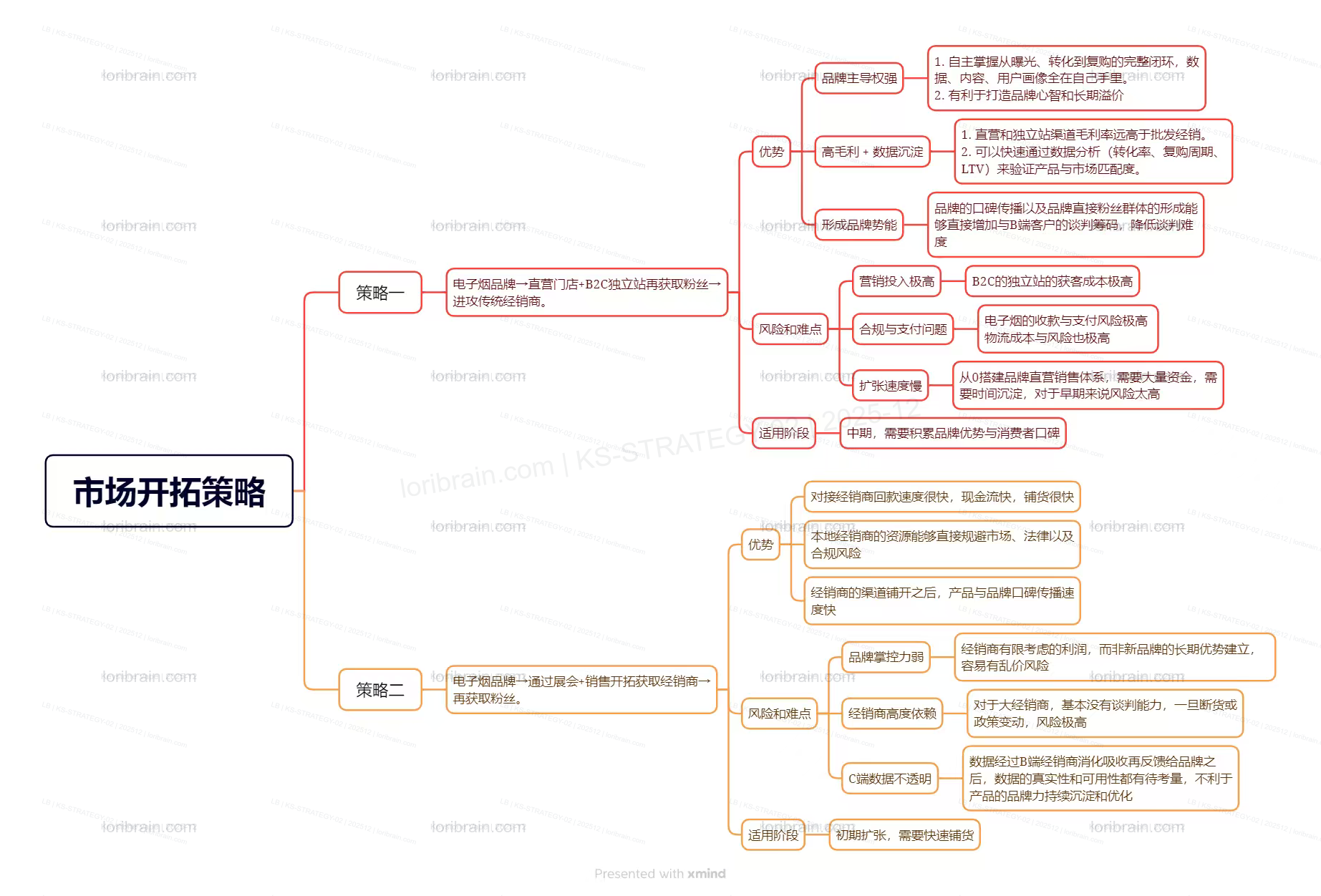
The approach I now find more convincing is to select a small number of priority markets, define target distributors and the sales path, and have local sales, retained creators, and the brand team work together. At the same time, the team should track not only search, content, and brand awareness, but also qualified opportunities, samples, orders, distribution, and repeat purchases.
Today, Keystone Vape products can be found for sale in some markets, with consumers also discussing and reviewing them. This suggests that the B2B development Frank continued to pursue has produced results. I am genuinely happy for Keystone Vape and for Frank.
This experience ultimately changed how I understand growth: sustainable growth comes from a feedback loop between real consumer demand generated through product use and the distributor coverage, fulfillment capabilities, and sales execution needed to serve that demand.